ITAD Vendor Checklist: What to Ask Before You Sign
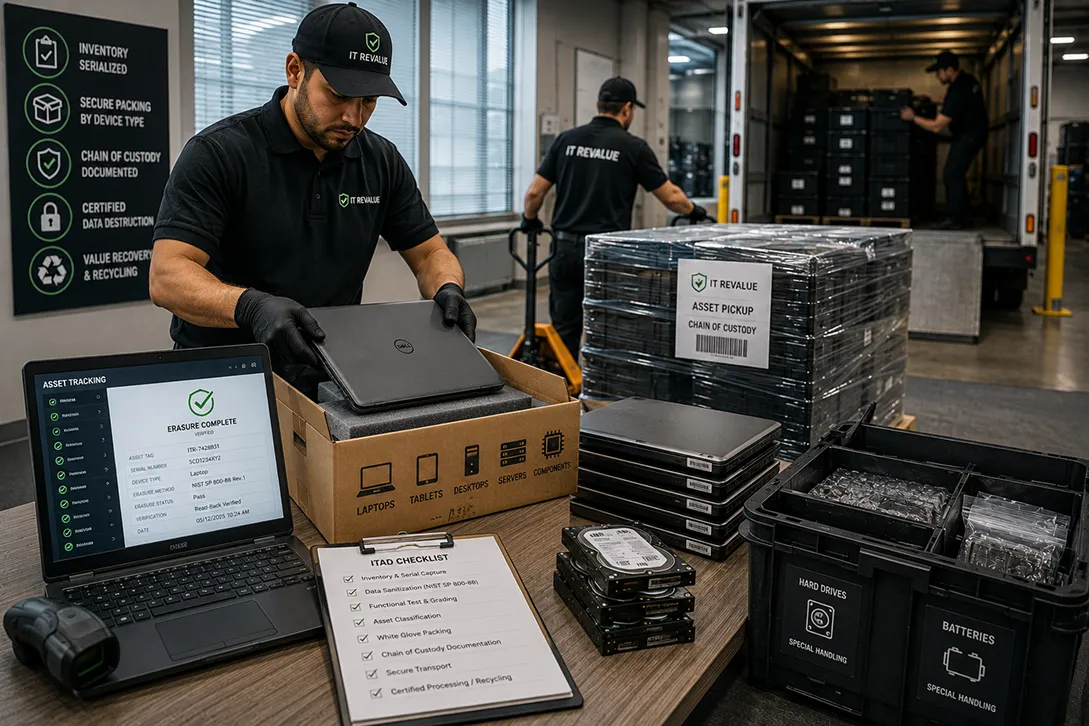
Summary
- What it is: the questions to put to ITAD vendors before a contract is signed, with why each one matters and what a complete answer looks like.
- The four question groups: data security and sanitization, certifications and compliance, chain of custody and logistics, and value recovery and settlement.
- How to use it in an RFP: each group maps onto one section of an ITAD RFP. Score every answer as documented, claimed or unanswered, and treat an unanswered question as a finding.
- Download: the full checklist is on this page and free to use. A fillable PDF version with score and notes columns is available at the end.
Most of what separates one ITAD vendor from another shows up in what it can put in writing before equipment leaves your building. This checklist sets out the questions to ask, why each one matters and what a complete answer contains, so the answers from every vendor on a shortlist can be compared side by side. If the term is new, start with what ITAD is and what an engagement produces.
How to Use This Checklist
Put every question to every vendor on the shortlist, IT Revalue included, and score each answer one of three ways:
- Documented: the vendor answered and backed the answer with something you can keep, such as a certificate, a sample record or a written procedure.
- Claimed: the vendor answered, but nothing backs the answer yet. Ask for the document before the contract is signed.
- Unanswered: no answer, or an answer to a different question. Treat it as a finding, not as something to chase later.
In an ITAD RFP, the four groups map onto four sections: data security, certifications and compliance, logistics and chain of custody, and commercial terms. Paste each group into its section as written and ask vendors to answer in the same order.
The third column of each table says where the expected answer comes from: NIST SP 800-88 Rev. 2 for the sanitization questions, the public materials of the bodies behind each certification for the compliance questions, and IT Revalue's documented process for the custody, logistics and settlement questions, where it sets out what a vendor should be able to show. There is no survey behind this checklist, no statistic and no scoring benchmark.
Data Security and Sanitization
These questions test whether a vendor's sanitization process will hold up when an auditor asks about one specific device. They follow NIST SP 800-88 Rev. 2, the current revision of the federal guideline for media sanitization; the NIST 800-88 guide explains its terms in plain English, and IT Revalue's own approach is on the secure data destruction page.
| Question to ask | Why it matters | What a complete answer looks like |
| Which sanitization method do you use for each media type in this lot: hard drives, SSDs, flash media, mobile devices and tape? | One method does not fit every media type. Degaussing works only on magnetic media, and an overwrite through the normal interface cannot reach every cell on an SSD. | The method (Clear, Purge or Destroy) and the technique for each media type, for example the drive's sanitize command or cryptographic erase for SSDs, and confirmation that flash storage is never degaussed. Source: NIST SP 800-88 Rev. 2, Sec. 3.1 and 3.2. |
| Which revision of NIST SP 800-88 does your process follow? | Rev. 2 was published in September 2025 and supersedes Rev. 1 from December 2014. A vendor that still cites Rev. 1 has not updated its process documents. | The revision named, with a written procedure that uses its terms. A general statement of following NIST, with no revision, is not a complete answer. Source: NIST SP 800-88 Rev. 2, Publication History and Appendix D. |
| What does the record for each sanitized device show, and can we see a sample? | An auditor asks whether a particular drive was sanitized. Only a per-device record answers that; a lot summary cannot. | A sample record showing, for each device, the manufacturer, model and serial number, the media type, the method and technique, the tool and its version, the verification method, and who verified it and when. Source: NIST SP 800-88 Rev. 2, Sec. 4.6 and Appendix C. |
| How is each sanitization verified, and what happens to media that fails? | A tool can report completion on a drive it did not fully sanitize. Verification catches that, and the response to a failure decides whether the data is still there. | The verification step (tool completion status, errors and device health after Clear or Purge; inspection of the remnants after Destroy) and a rule that failed media is sanitized again with a different technique or destroyed, with the outcome recorded against the serial number. Source: NIST SP 800-88 Rev. 2, Sec. 4.5. |
| Who has physical access to the equipment between pickup and sanitization, and where is it held? | Devices still hold data until they are sanitized, so transport and storage are when the data is most exposed. | The named custody points from your dock to the processing floor, who handles the equipment at each one, how storage is access controlled, and when each device is recorded along the way. Source: NIST SP 800-88 Rev. 2, Sec. 4.3.4 and Sec. 4.6, on control of media and tracking it from entry to final destination. |
| Is physical destruction done in your own facility or by a partner, and which one? | Subcontracted destruction moves your media to another company's site. You need to know whose facility it is and whether its records come back to you. | In-house or partner, stated plainly. For a partner: its name, the facility address, its certification (verified as in the next group) and whether destruction records come back per device. Source: NIST SP 800-88 Rev. 2, Sec. 2.4 and Sec. 3.1.3 (Destroy). |
Certifications and Compliance: What to Ask ITAD Providers
A certification is only as useful as its scope. The question to ask ITAD providers is which certifications they hold and what those certifications cover, not which ones sound impressive. Each certification in this group can be checked against a public directory or with the body that issued it, and it should be checked on the day you decide.
| Question to ask | Why it matters | What a complete answer looks like |
| Which standards is the processing facility certified to, and by which certification body? | R2, e-Stewards, RIOS, NAID AAA and ISO 14001 or ISO 45001 cover different things. RIOS describes itself as a management system standard for quality, environment and health and safety; NAID AAA certification applies to physical and electronic media destruction. | Each standard and version named, with the certification body, certificate number, expiry date and a copy of each certificate. NIST SP 800-88 should appear as a guideline the process aligns with, never as a certification. Verify each one in the public directory: R2 Directory (SERI), e-Stewards, RIOS, and i-SIGMA's compliance tracker for NAID AAA. Confirm ISO certificates with the certification body that issued them. |
| Does the certificate cover the facility that will actually process our equipment? | Certification is tied to a facility. The R2 Directory, for example, lists each certified facility at its address and marks facilities that have moved or closed. | The address on the certificate matches the site that will receive and process your equipment, and the directory shows that site as certified. A certificate held by a corporate parent for a different location does not count. Source: SERI, Understanding R2 Directory Search Results. |
| What does the certificate's scope include? | A certificate can cover some of a facility's processes and not others. An R2 facility may be certified for logical data erasure, physical destruction, test and repair or materials recovery, and NAID AAA endorsements define services such as on-site or facility-based destruction and specific media types. | The scope statement or list of endorsements, with the services you are buying (sanitization, destruction, resale, recycling) inside it. Source: SERI, R2 Directory field definitions (Appendices A to G); i-SIGMA, NAID AAA Certification program page. |
| When was the last audit, and is the certification active today? | Certifications are kept through recurring audits and can lapse. The R2 Directory separates active, suspended, expired and revoked certificates, and NAID AAA includes unannounced audits. | The date of the most recent audit, whether any major nonconformities are open, and an active status in the directory on the day you check. Source: SERI, R2 Directory status definitions; i-SIGMA, NAID AAA Certification program page. |
| How are downstream partners qualified and monitored? | Equipment that leaves the vendor for recycling, destruction or resale takes your data and environmental exposure with it. R2 treats sending equipment to downstream vendors as its own requirement, Appendix A. | The categories of downstream partner used, how each is qualified (certification, audit, contract terms), how often each is reviewed, and whether records of the final outcome come back to you. Source: SERI, R2 Directory field definitions (Appendix A, Downstream Recycling Chain). |
Chain of Custody and Logistics
Chain of custody is the record that shows no device could have gone missing between your building and its final outcome. These questions establish where that record starts, what it captures and whether it covers every site. What a full custody record contains is set out in IT Revalue's data security and chain of custody documentation. For the custody questions in more depth, see chain of custody in ITAD: vendor questions.
| Question to ask | Why it matters | What a complete answer looks like |
| Where does custody pass from us to the vendor, and who signs at that point? | Until custody passes in writing, it is unclear who is responsible for a device that goes missing. | A named transfer point at your facility, a signed transfer record created at pickup, and each later handoff listed through to final disposition. Source: IT Revalue's documented process (signed transfer records from the point of pickup). |
| Is each device recorded by serial number before it leaves our building, or only when it reaches the processing facility? | An inventory started at the receiving dock leaves a gap: a device lost in transit never appears on any list. | A serialized inventory created on site before anything leaves the building. Source: IT Revalue's documented process (serialized inventory at pickup). |
| How do you handle collection from more than one site? | Separate pickups under separate paperwork produce separate records that someone then has to reconcile. | Scheduling coordinated across all locations under one engagement, with documentation covering every collection site under a single chain-of-custody record. Source: IT Revalue's documented process (multi-site collections). |
| Who packs, palletizes and arranges freight, and what are we expected to supply? | Packing by your own staff costs internal labor, and it is where devices get damaged or left off the inventory. | Who packs and palletizes on site, who supplies the packing materials, how smaller shipments are handled (for example with prepaid labels), and how logistics costs are treated in the offer. Source: IT Revalue's documented process (collection logistics). |
| What is recorded at each handoff, and what custody record do we receive at the end? | The custody record is what you show a regulator, a client or internal audit, so what it contains matters more than its format. | A record of who collected the equipment, when and from which location, what each device evaluated to, how it was sanitized and where it ultimately went. Source: IT Revalue's documented process (chain-of-custody documentation). |
Value Recovery and Settlement
These questions make the commercial side of each offer comparable. How a buyback offer is put together is covered on the IT asset buyback page.
| Question to ask | Why it matters | What a complete answer looks like |
| How is the offer built, and does it cover the whole lot or individual line items? | Two offers can only be compared if they are built on the same basis. | The pricing basis stated (for example fair market value minus processing cost), the device details that move it (model, specifications, cosmetic condition, battery health, functionality, account-lock status), and whether one offer covers the full lot. Source: IT Revalue's documented process (how pricing is determined). |
| Is the offer firm before evaluation, and what can change it afterward? | An offer that shrinks after evaluation is worth less than it first looked. | The conditions that can adjust the offer after evaluation named in advance (account locks and battery condition are the most common), and line-item questions answered before anything ships. Source: IT Revalue's documented process (buyback offer). |
| Are logistics costs deducted from the offer or invoiced separately? | Packing, freight and labor billed after the fact change the net result of the engagement. | A written statement, before equipment ships, of how packing, haulaway and shipping are handled, so the offer reflects the full net payout. Source: IT Revalue's documented process (fees and logistics). |
| What happens to equipment that cannot be remarketed, and is there a charge for it? | Not everything in a lot will resell. Its route and its cost belong in the comparison, and its data handling should be the same as for everything else. | The route for equipment that cannot be resold (recycling through certified downstream partners), whether it carries a charge, and confirmation that its outcome is documented for every device. Source: IT Revalue's documented process (devices that cannot be remarketed). |
| When does settlement land, and what does it show? | Finance needs the settlement to close the project and reconcile the asset register. | The point at which payment issues (for example once processing is complete), a typical timeline from first contact through payment, and the outcome for each device. Source: IT Revalue's documented process (payment timing). |
The Documents a Complete Engagement Produces
- The serialized erasure record. One record per device with its serial number, the sanitization method, the date and time, and a pass or fail result. It proves a specific device was sanitized.
- The certificate of data destruction. A certificate naming the devices, the method, the processing date and the record reference. It is what a compliance team files to close out the disposition and what an auditor asks to see.
- The chain-of-custody record. Every handoff from collection to final outcome. It shows there was no point at which a device could have gone missing unnoticed.
- The settlement. What was paid or charged, and what happened to each device. It is what finance uses to reconcile the asset register.
Ask each vendor which of the four are issued as standard and which only on request, and put the answer in the contract. At IT Revalue, specialized device auditing software archives an erasure record for each device in a secure database at the time of processing, and a certificate of data destruction names each device by serial number.
Red Flags
- A batch certificate without serial numbers. A certificate that covers a pallet or a device count cannot show that a particular device was sanitized.
- A certification named without its scope. A logo says nothing about which facility or which processes the certificate covers. Check the directory.
- Subcontracted processing described as in-house. If destruction or recycling happens at a partner's site, the partner's facility and certification are what matter. Ask directly.
- A firm quote before an inventory. An offer made before anyone knows the models, quantities and condition will be revised once the equipment is evaluated.
- No answer on which revision of the standard is in use. A claim of NIST compliance with no revision named gives you nothing to check. Rev. 2 has been current since September 2025.
Download the ITAD Vendor Checklist
The PDF holds the same questions laid out for a vendor meeting: a page of instructions, the four question tables with a fillable score column and notes column for every question, and a final page for the reviewer's summary and sign-off. It can be filled in on screen or printed. The checklist on this page stays complete without the form.
Enter your work email below and the download link appears.
Free to use with any ITAD vendor. Your details are sent to the IT Revalue team; tick the box if you would like a call about an upcoming project.
Ready to Put These Questions to IT Revalue?
Submit your equipment list for a response within one to two business days and pricing within one week. No obligation.