How much is used IT equipment worth?
Key takeaways
- There is no price list. Value is set device by device against what the secondary market will pay at the time of evaluation.
- Model and age come first. A current business model with strong specifications holds value, and a superseded generation loses it with every quarter in storage.
- Batteries and locks move the number. A worn battery pulls a device down a grade, and a device locked to a previous account is valued as non-functional.
- Lot size matters. Larger, consistent lots spread processing and logistics cost across more devices, which lifts the value of each one.
- A detailed list gets a real number. Models, configurations, counts, and condition turn an estimate into a formal offer.
Why There Is No Price List
How much is used IT equipment worth? It is the first question an IT manager asks when a refresh leaves a room full of retired laptops, desktops, and servers. There is no figure to look up. Used IT equipment value depends on what the equipment is, what condition it is in, what the secondary market will pay for it this quarter, and how well the lot is documented. All of those factors are knowable, and understanding them is how a disposal cost becomes value recovery.
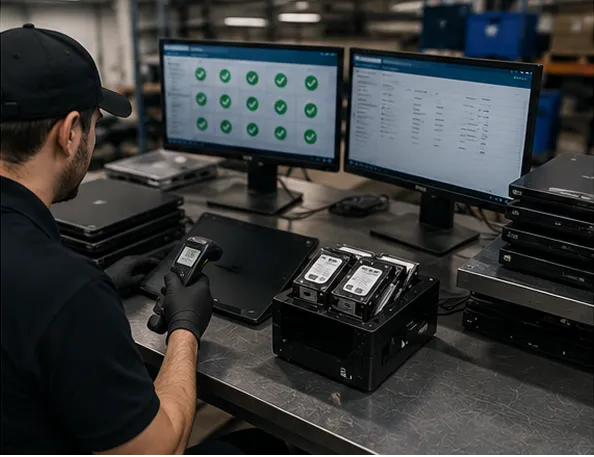
An offer starts from fair market value, what the equipment can be resold for after it has been tested, sanitized, and graded, and accounts for the cost of that work and the logistics to get it there. Functional testing, grading, and NIST SP 800-88 data wiping are done in-house at the Bellflower, California facility, with an erasure record for every device. Valuation happens device by device, and demand shifts with supply and new releases, so an offer is tied to the time of evaluation.
Model and Specification
The model sets the ceiling. Business lines with steady secondary demand, such as mainstream corporate laptops and Apple devices, hold value better than consumer or niche models. Within a model line, higher specifications recover more: more RAM, larger and faster storage, discrete graphics, and higher-tier processors widen the pool of buyers who can use the device. Components such as GPUs, RAM, CPUs, and drives can also be bought back on their own.
Detail matters here. A list that says "40 laptops" gets a rougher estimate than one that says "40 Dell Latitude 5430, i5, 16GB, mixed cosmetic grade, all power on."
Age and Condition
Age works through generation rather than the calendar. A processor generation that is still current in the secondary market holds value; one that has been superseded twice does not. Business equipment holds meaningful resale value for roughly three to five years from purchase, and a device that sits in storage for an extra year after retirement loses value for no reason other than time.
Condition is graded in tiers based on scratches, dents, screen condition, keyboard wear, and whether every function works. Fully functional units in clean condition sit at the top, and units with cosmetic damage but full function sit in the middle. Non-functional units are still accepted, with their value coming from recoverable parts and materials rather than resale. You can see how each tier is assigned in the grading process.
Battery Health and Cycle Count
For laptops, tablets, and phones, the battery is assessed on its own. Cycle count and remaining capacity against the original design tell a buyer how much useful life is left. A laptop with a healthy battery resells as ready to use; one with a worn battery needs a replacement before resale, and that cost comes off its value. Note any swollen batteries on your list, since they need separate handling.
Account Locks and Activation State
This factor surprises people. A device that is still locked to a previous user, through Apple Activation Lock, a Chromebook's Google account, Windows BitLocker, or enrollment in a device management platform, cannot be resold as a working machine until the lock is cleared. Locked devices are valued as if they were non-functional. Unenrolling devices and clearing locks before pickup is the cheapest thing a business can do to raise the value of a lot.
Pro Tip: Before you request a quote, sort the lot into "powers on and unlocked," "powers on but locked," and "does not power on." Clearing the locks in the second group is often worth more than any other prep you can do.
Lot Size and Mix
Larger, more uniform lots are worth more per unit than small, mixed ones. Processing and logistics costs are spread across more devices, and a consistent lot of the same model is easier to test, grade, and resell than an assortment. In practice, roughly 50 units is where a dedicated buyback project usually makes sense, and servers are assessed on their own rather than counted toward that figure. Mixed lots are welcome; the offer reflects the mix. See what we buy for the full list, from laptops, desktops, and Chromebooks to tablets and iPads, smartphones, servers, and components.
How to Get an Actual Number
Submit an equipment list with:
- Model and configuration: manufacturer, model, processor, RAM, and storage for each device type. An export from your asset management system or MDM is usually fastest.
- Quantities by model: counts per configuration rather than a single total.
- Condition notes: how many power on, known cosmetic damage, and any failed screens, batteries, or boards.
- Lock status: whether devices are unenrolled and cleared of Activation Lock, Google accounts, or BitLocker.
- Location and timing: where the equipment is staged and any deadlines, such as lease returns or fiscal-year cutoffs.
From that list you receive one offer for the whole lot. You hear back within one to two business days confirming pricing is underway, and a formal offer follows within about a week. Packing materials and freight are arranged, logistics costs are deducted from the payout rather than invoiced, and payment is Net 30 from completion of processing. If an outright purchase is not the right fit, ITAD as a service is the alternative: the lot is processed and remarketed on your behalf on a commission basis. An online pricing tool for quick estimates will follow, and the formal offer will still be built from your list. IT Revalue, the ITAD division of PN California, processes under R2v3 (responsible recycling and data security) and RIOS.
Frequently Asked Questions
Are old computers worth anything?
Often, yes. Business desktops and workstations within roughly three to five years of purchase usually have resale demand, and older or non-working machines can still carry value in components. An equipment list is the only way to know for a specific lot.
Are old laptops worth anything?
Usually. Business laptops have the most consistent resale demand of any device type. Model, generation, specification, condition, and battery health set the value, and a laptop still locked to an account is valued as non-functional until the lock is cleared.
What happens to units with no resale value?
They are still accepted. After the data is destroyed, recoverable parts are pulled for reuse, and the rest goes to certified downstream recycling partners for material recovery. Nothing goes to landfill, and each serial number is recorded.
Value is set by model, age, condition, battery health, lock status, and lot size, and a detailed list is what turns those factors into a number. If you have a lot ready to move, request a buyback quote and receive one offer, with data destruction and full documentation built in.
Request a Buyback Quote
Submit your equipment list to receive a buyback offer within one to two business days. No obligation.